
BLOG
Why Asking About Firearms Can’t Be Optional in Emergency Behavioral Health Care
By: Sara Gotheridge, MD, Chief Medical Officer at Array Behavioral Care
If you’re serious about suicide prevention, you have to start with one question: Does this patient have access to a firearm?
Firearms account for more than half of suicide deaths in the U.S., and attempts involving a firearm are far more likely to result in death than other methods.1,2,3 That makes firearm access one of the most important and actionable risk factors health systems can assess.
Yet in many healthcare settings, this question is often not asked consistently, not documented clearly, or quietly ignored when the answer isn’t known.
At Array, we take a different approach. We require clinicians to ask and document firearm access every time: yes, no, or unknown. This ensures one of the most important drivers of suicide risk is always addressed.
And we don’t stop there. We also give clinicians a structured way to respond when the answer isn’t clear.
Most systems treat “unknown” like a gap. We treat it like a signal.
The combination of consistently capturing firearm access and knowing how to act when it’s uncertain is what sets our acute care model apart.
Start With What Matters Most: Firearm Access
Firearm access is one of them.
Research consistently shows:
- More than half of suicide deaths involve firearms1,4
- Firearm attempts are far more likely to be fatal than other methods.2,3 Reducing access during high-risk moments saves lives3,5
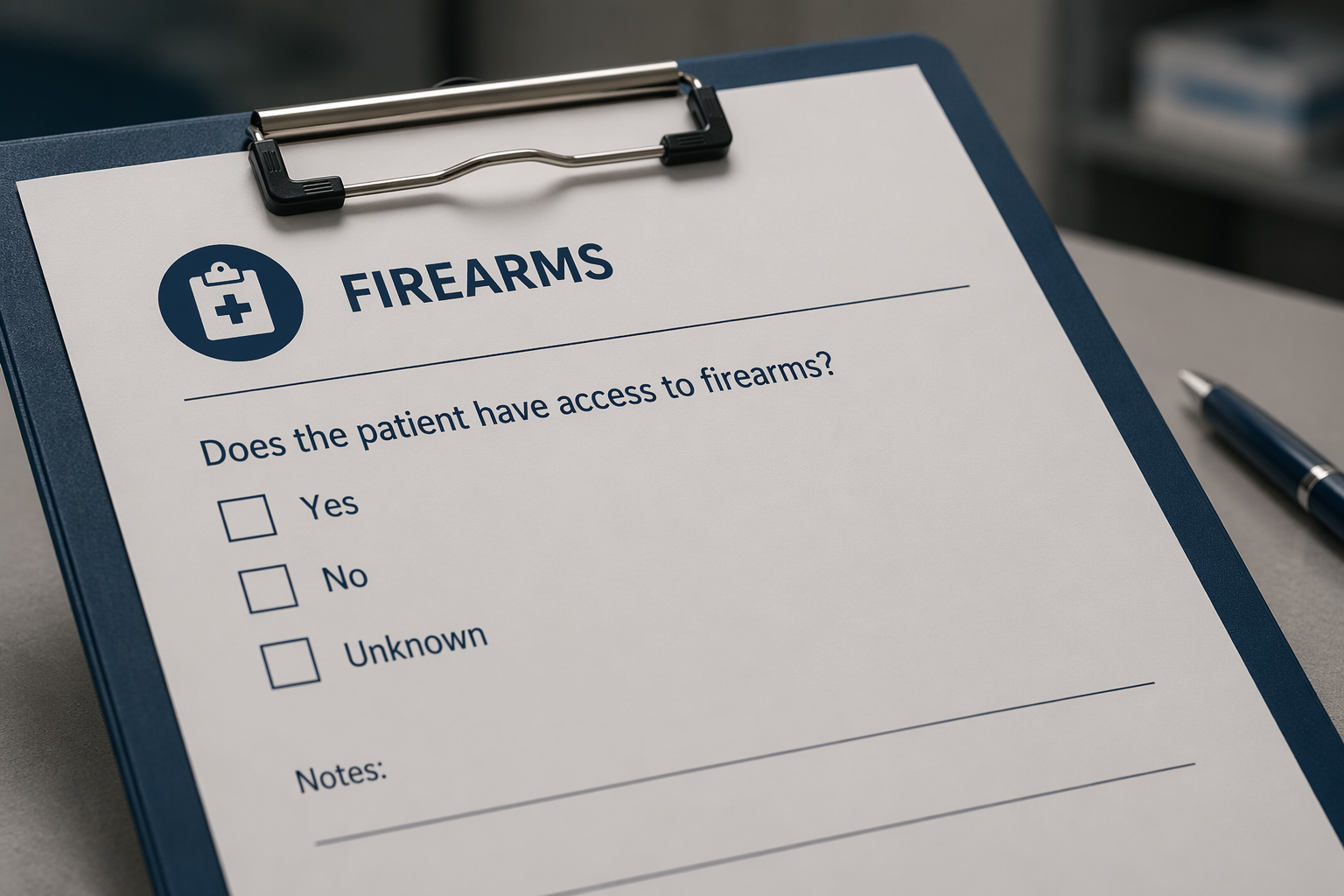
Because of this, asking about firearm access should be standard practice. It should not be optional or inconsistent. At Array, it is standard. Every evaluation requires a clear answer:
☐ Yes
☐ No
☐ Unknown
No skipping. No assumptions.
This simple step ensures that one of the most important risk factors in suicide prevention is never overlooked.
The Problem Most Systems Ignore
In many organizations, when firearm access isn’t known, one of two things happens:
- The field is left blank
- Or worse, it’s treated as “no” by default
Both approaches create risk.
They create a false sense of safety and can lead to underestimating a patient’s true risk.
But in real-world emergency care, “unknown” is common.
Patients may be:
- Medically unstable
- Intoxicated or disoriented
- Unable or unwilling to provide reliable information
So the question isn’t whether uncertainty exists.
It’s what you do with it that matters.
Array’s Difference: We Don’t Ignore “Unknown”
At Array, our acute care model is built on a simple idea:
If something is important, you have to capture it. If you capture it, you have to use it.
That’s why “unknown” is not treated as a data problem.
It’s treated as real clinical information.
When clinicians select “unknown,” they’re not skipping the question. They’re documenting a real limit in what can be known at that moment.
And when you look at the data, that distinction becomes critical.
What the Data Shows
Because we require structured documentation, we’ve built one of the largest real-world datasets in acute behavioral health that is drawn from tens of thousands of encounters across emergency and acute care settings.
We looked at how clinicians actually document firearm access (“yes,” “no,” or “unknown”) and asked a question the literature rarely does:
Are these three categories really interchangeable?
They aren’t.
Patients whose firearm access is documented as “unknown” are substantially more likely to show other signs of acute risk than patients with confirmed access or no access:
- 36% show signs of psychosis
- 24% show signs of agitation
- Psychosis rates are nearly 10 percentage points higher in the “unknown” vs. the “yes” group
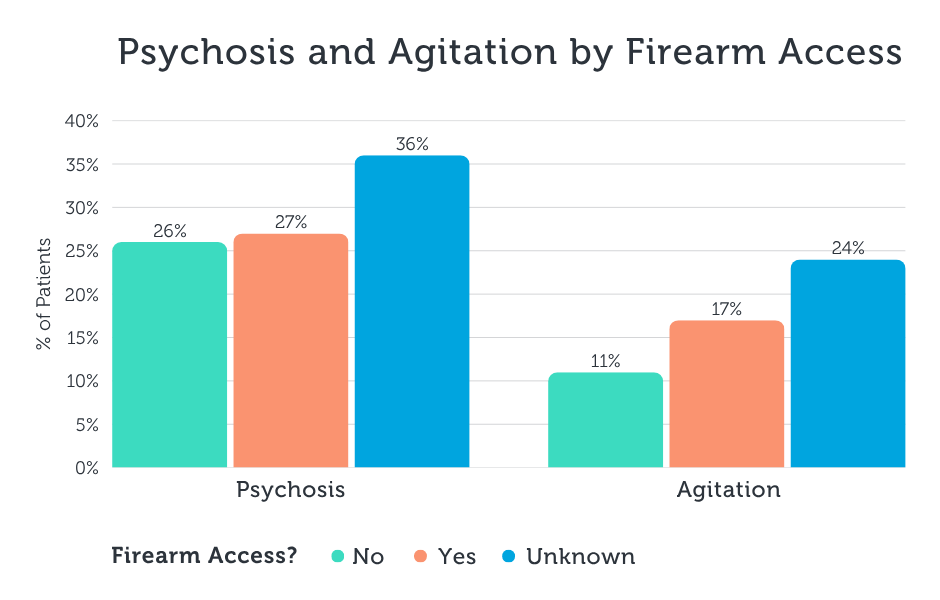
The takeaway is simple:
When firearm access is unknown, patients tend to be more unstable and more complex.
In other words, “unknown” behaves more like a red flag than a “no.”
This is exactly the kind of insight that only large-scale, real-world clinical data can reveal. Few organizations have visibility into care at this level, which is why it matters that this data is being brought forward.
Why This Matters Clinically
When uncertainty is ignored or oversimplified, it creates real problems:
- Clinicians carry more cognitive burden
- Decisions become less consistent
- Risk can be underestimated
Research on clinical decision-making shows that missing or ambiguous information increases variability and raises the risk of error when left unstructured.6,7,8
But when uncertainty is structured and visible, it becomes something clinicians can use.
That’s what our acute care model is designed to do:
- Requires clear documentation of firearm access
- Makes uncertainty explicit
- Incorporates it into clinical decision-making
- Supports more consistent and defensible outcomes
This doesn’t replace clinical judgment. It strengthens it.
What This Means for Health System Leaders
For healthcare organizations, this isn’t just documentation. It’s care design.
Getting firearm access right, and handling uncertainty correctly, directly impacts:
- Patient safety
- Quality and consistency of care
- Risk management
- Medical-legal defensibility
Organizations don’t fail because uncertainty exists.
They fail when they don’t design systems to handle it.6
The Bottom Line
If you want to reduce suicide risk, you have to start by asking about firearm access every time.
And if you want to make better decisions, you can’t ignore when the answer is unknown.
At Array, we do both:
1We make firearm access a required, visible part of every assessment
2We treat uncertainty as meaningful and build it into how clinical decisions are made
Because in emergency behavioral health care, the most important decisions are often made without perfect information.
And the organizations that deliver the safest care aren’t the ones that avoid uncertainty.
They’re the ones designed to handle it.
References
-
- Kaiser Family Foundation. (2026). Suicide deaths: National trends and variation by demographics and states. https://www.kff.org/mental-health/suicide-deaths-national-trends-and-variation-by-demographics-and-states
- Ajdacic-Gross, V., Weiss, M. G., Ring, M., Hepp, U., Bopp, M., Gutzwiller, F., & Rössler, W. (2008). Methods of suicide: international patterns from the WHO mortality database. Bulletin of the World Health Organization, 86(9), 726–732. https://doi.org/10.2471/BLT.07.043489(
- Harvard T.H. Chan School of Public Health. (2022). Means matter: Suicide case fatality rates by means. https://www.hsph.harvard.edu/means-matter
- Johns Hopkins Center for Gun Violence Solutions. (2026). Firearm suicide. Johns Hopkins Bloomberg School of Public Health. https://publichealth.jhu.edu/center-for-gun-violence-solutions/issues/firearm-suicide
- Miller, M., Azrael, D., & Barber, C. (2012). Suicide mortality in the United States: the role of method in understanding population-level disparities. Annual Review of Public Health, 33, 393–408. https://doi.org/10.1146/annurev-publhealth-031811-124636
- Helou, M. A., DiazGranados, D., Ryan, M. S., & Cyrus, J. W. (2020). Uncertainty in medical decision-making: a scoping review and thematic analysis. Academic Medicine, 95(1), 157–165. https://doi.org/10.1097/ACM.0000000000002902
- Simonovic, N., Taber, J. M., Scherr, C. L., Dean, M., Hua, J., Howell, J. L., & Politi, M. C. (2022). Five methodological and conceptual research recommendations on uncertainty in health care and health decision making. Journal of Behavioral Medicine, 46, 1–14. https://doi.org/10.1007/s10865-022-00384-5
- Han, P. K. J., Klein, W. M. P., & Arora, N. K. (2011). Conceptual taxonomy of various kinds of uncertainty in health care. Medical Decision Making, 31(6), 828–838. https://doi.org/10.1177/0272989X11393976

Chief Medical Officer at Array Behavioral Care
Sara Gotheridge, MD, is the Chief Medical Officer at Array Behavioral Care, where she leads the clinical team and oversees the quality program. With a 25-year career dedicated to expanding behavioral healthcare practices, Dr. Gotheridge brings deep expertise in integrated care, having previously held leadership roles at LifeStance Health and Trilogy Behavioral Healthcare.